
 Readership
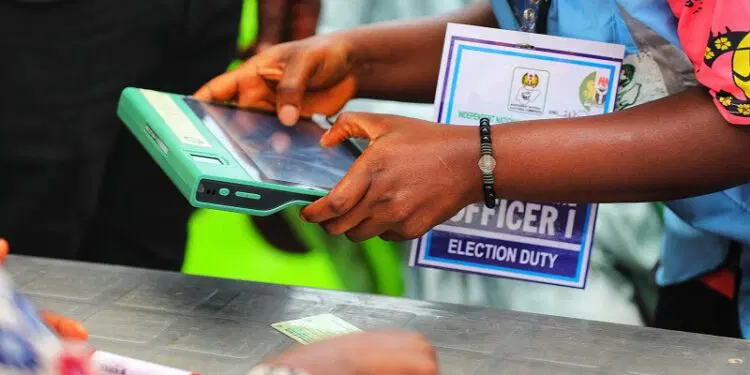
The Independent National Electoral Commission (INEC) will today conduct a nationwide mock accreditation and result transmission exercise across the 36 states of the federation and the Federal Capital Territory (FCT), about seven weeks before the 2027 general elections.
INEC Chairman, Professor Joash Amupitan, disclosed this on Thursday at the INEC and Office of the National Security Adviser (ONSA) Strategic Election Security Conference in Abuja.
He said the exercise would test the Commission’s newly acquired equipment and result transmission systems under real-life conditions ahead of the elections.
According to him, the exercise would allow INEC to assess its upgraded Bimodal Voter Accreditation System (BVAS) devices and verify the enhanced validation safeguards of the INEC Result Viewing Portal (IReV), designed to automatically detect arithmetic inconsistencies and over-voting.
He added that the exercise would also serve as an operational rehearsal for the Commission’s security arrangements in collaboration with relevant security agencies.
The presidential and National Assembly elections are scheduled for January 16, 2027, across 177,299 polling units, while governorship and State Houses of Assembly elections will hold on February 6, 2027.
Amupitan disclosed that INEC had procured new accreditation machines and introduced a reduced voter threshold for the actual elections.
He said the Commission would deploy more than 1.41 million ad hoc personnel alongside 57,000 newly procured BVAS devices, each calibrated to accredit a maximum of 850 voters.
The INEC chairman emphasised that the mock exercise was not just a test of technology but also an opportunity to assess coordination between the electoral body and security agencies.
Describing the importance of the exercise, he said, “Strategy without rehearsal is merely aspiration.”
He urged Resident Electoral Commissioners and Commissioners of Police across the states to participate fully in the exercise, stressing the need to test communication channels, assess emergency response times and identify possible logistical and security challenges ahead of the elections.
Amupitan specifically called on the officials to treat November 28 as a full-scale operational rehearsal, noting that any identified shortcomings should be addressed before the actual elections.
INEC had earlier released the list of polling units selected for the nationwide mock accreditation and result upload exercise, covering 17,656 locations across the 36 states and the FCT.
The Commission explained that the exercise would utilise the BVAS technology to simulate the accreditation and result transmission processes ahead of the general elections.
The published list contains details of the selected polling units, including their respective states, local government areas, wards, polling unit numbers and delimitation codes.
The selection covers all states alphabetically, from Abia to Zamfara, with the Federal Capital Territory listed last.
Abia State has 368 selected polling units, while Adamawa has 452. In the FCT, 124 polling units were selected across the six area councils.
Abaji, Bwari, Gwagwalada, Kuje and Kwali have 20 selected polling units each, while the Abuja Municipal Area Council has 24.
The mock exercise will simulate the presidential election, with polling units expected to open at 8:30 a.m. Accreditation will run until 2:30 p.m.
INEC maintained that the exercise was designed to identify and correct possible technical and operational challenges before the actual elections.
The Commission stressed that discovering faults during the rehearsal would help strengthen the electoral process, noting that the purpose was to identify problems while there was still sufficient time to resolve them.