How Isese Day Is Reclaiming Its Place In Yoruba Society
About The Author


How Isese Day Is Reclaiming Its Place In Yoruba Society
By Lateef Owodunni – Readership NG
The sound of the Bàtá drum carries a familiar message across Yorùbá communities today as the people mark Ìṣẹ̀ṣe Day, a celebration of traditional religion, culture and ancestral heritage. For many adherents, however, the day is about much more than drumming, dancing and colourful displays. It is a time to reconnect with a tradition that has survived generations of pressure, neglect and misunderstanding. Ìṣẹ̀ṣe remains closely tied to the Yorùbá understanding of life, nature, character, the ancestors and the spiritual forces believed to shape human existence.
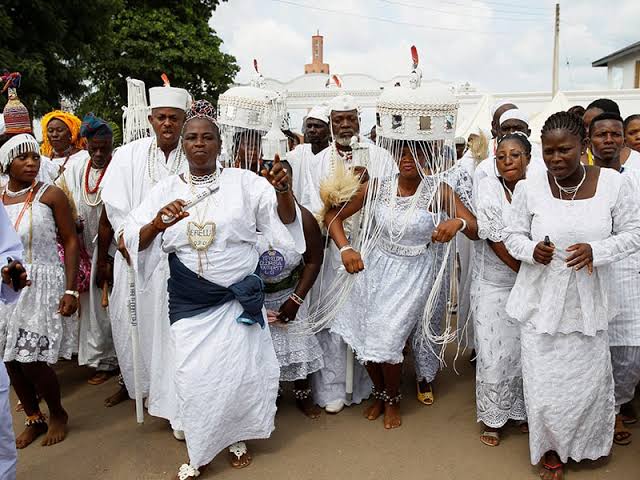
In communities where the celebration is taking place, traditional worshippers observe different rites according to their customs and spiritual lineages. Prayers and homage are offered to Olódùmarè, the Òrìṣà and the ancestors, while libations and other traditional offerings form part of some ceremonies. There are also processions, chanting, dancing and drumming, with Ifá consultations taking place in some communities. The ceremonies may differ, but they share a common purpose: preserving a spiritual tradition that has been handed down from one generation to another.
For years, many people were reluctant to openly identify with traditional religion. Colonial influence, the spread of Christianity and Islam, and the negative perception often attached to indigenous worship pushed many practices away from public view. That appears to be changing. Across Yorùbá communities today, there is a growing willingness to speak about indigenous culture, learn the Yorùbá language, study Ifá and take pride in traditional names, clothing, music and customs. Among younger people in particular, what was once regarded by some as something to be ashamed of is increasingly being viewed as an important part of their identity.
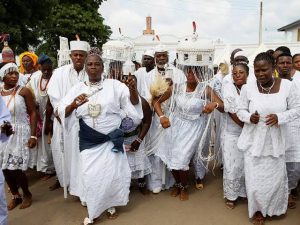
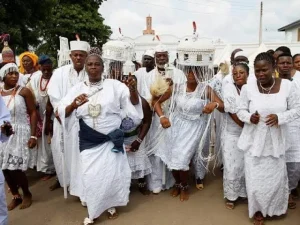
Women have been an important part of that change. The Ìyá Òrìṣàs and other female custodians of traditional worship continue to preserve rituals and pass knowledge to younger generations. Their appearance during ceremonies, often marked by white clothing, beads and traditional headgear, has become one of the most recognisable features of Ìṣẹ̀ṣe celebrations. More importantly, many of these women are no longer willing to keep their religious practices behind closed doors. They participate openly in ceremonies and speak with confidence about a tradition they believe deserves respect.
Men are also increasingly embracing their heritage in the open. Traditional rulers, cultural figures, businessmen, politicians and other members of the society are regularly seen participating in cultural events and wearing indigenous attire. The change is particularly noticeable in cities, where traditional clothing and symbols have moved beyond the confines of the village square and into public celebrations, social events and other gatherings. For many, there is no longer a need to choose between being modern and being connected to one’s roots.
The story of Ìṣẹ̀ṣe, however, does not end in Yorùbáland. The tradition has a significant presence among Yorùbá descendants and practitioners in countries such as Brazil, Cuba, Trinidad and Tobago, the United States and parts of Europe. Centuries after Yorùbá traditions were carried across the Atlantic through the transatlantic slave trade, elements of the culture and spirituality have survived in different forms. The growing interest among members of the diaspora has also created stronger cultural links with Nigeria, particularly with communities and traditional institutions in the Southwest.
The recognition of Ìṣẹ̀ṣe Day by governments in the Southwest has further brought the celebration into the mainstream. Lagos, Ogun, Oyo and Osun states have declared August 20 a work-free day for the 2026 celebration. The decision has been welcomed by traditional worshippers and cultural groups, who see it as recognition of the place of indigenous religion and culture in the Nigerian society. It also sends a wider message about religious freedom and the need for governments to recognise the country’s different cultural and religious traditions.
But perhaps the most important question is what happens after the drums stop. Preserving Ìṣẹ̀ṣe cannot depend on one day of celebration each year. Its survival will depend on whether the language, history, traditional knowledge, music, art, festivals and spiritual practices are properly documented and passed on to younger generations. For those who celebrate Ìṣẹ̀ṣe, August 20 is therefore not simply another public holiday. It is an opportunity to look back at where the people came from, acknowledge what survived, and decide what should be carried forward.