
 Readership
Crude jumped more than two per cent and has spiked around 10 per cent this week after the United States hit an Iranian island in the Strait of Hormuz, sparking a series of tit-for-tat attacks in which Tehran has targeted American interests in several regional countries.
The latest round of military action comes after weeks of relative calm during which peace talks went nowhere, and Washington said it would aim for the “economic asphyxiation” of the Islamic republic.
With the strait — through which about a fifth of world oil and gas passes — effectively closed for the foreseeable future and energy costs unlikely to come down, inflation fears are growing.
That — along with worries over government spending and a flood of corporate debt sales — has sent rate hike expectations surging, putting upward pressure on government borrowing costs.
Japan’s 10-year bond yield is at a 30-year high, 30-year US Treasuries are just short of their 2007 mark, and the US 10-year yield is also at financial crisis levels.
“Bond yields were already rising, and the renewed US-Iran attacks and their impact on oil prices have made investors more concerned about bonds,” Rajeev De Mello, at Gama Asset Management, said.
“At these levels, higher yields are clearly a headwind to Asian equities, especially longer duration tech stocks.”
Hong Kong, Shanghai, Sydney, Singapore, Wellington, Taipei and Manila were also well off.
That followed losses across all three main indexes on Wall Street.
Investors are gearing up for the release of key data on jobs and inflation over the next week that could determine whether the Federal Reserve hikes rates at its next meeting in two weeks.
Fed governor Michael Barr stoked expectations by saying decision-makers should be prepared to hike if inflation stays stubbornly above the bank’s two percent target, which it has been for more than five years.
“If trends in the data give me some confidence that inflation is moderating on a path to two percent, then I think we can take a bit more time to assess our policy stance,” he said in prepared remarks.
“However, if inflation appears not to be moderating sufficiently, then I think we should act decisively to raise rates.”
Key Figures At Around 0230 GMT
West Texas Intermediate: UP 1.5 per cent at $91.60 per barrel
Brent North Sea Crude: UP 1.9 per cent at $96.45 per barrel
Tokyo – Nikkei 225: DOWN 2.6 per cent at 64,473,16 (break)
Hong Kong – Hang Seng Index: DOWN 1.1 per cent at 25,053.02
Shanghai – Composite: DOWN 1.1 per cent at 3,934.36
Dollar/yen: UP at 160.34 yen from 160.24 yen on Tuesday
Euro/dollar: DOWN at $1.1578 from $1.1589
Pound/dollar: DOWN at $1.3503 from $1.3511
Euro/pound: DOWN at 85.73 pence from 85.77 pence
New York – Dow: DOWN 0.8 per cent at 52,766.88 (close)
London – FTSE 100: DOWN 0.3 per cent at 10,789.28 (close)

Iran Strikes US
Iran struck US interests around the Middle East on Wednesday, vowing “severe” consequences for renewed American attacks on the Islamic republic.
The latest fighting over the Strait of Hormuz once again expanded to US military bases in the region and drew Washington’s Gulf allies deeper into the six-month conflict.
US President Donald Trump had warned earlier of “much harder and higher” attacks if Iran retaliated to the US strikes, which Iranian state media said had killed 11 people in the country’s south and southwest.
Tehran said it launched ballistic missile attacks on two US bases in Jordan, according to Iranian media.
The Jordanian army said it intercepted 10 ballistic missiles fired from Iran, and did not confirm any injuries or hits.
Three other missiles landed in remote areas, it said.
Missile and drone attacks were also reported in Kuwait, where the army said they were responding to Iranian hostilities, and AFP reporters in Bahrain heard air raid alerts ring out early Wednesday.

Iran’s army said it launched drone attacks targeting US forces at an air base in Bahrain, a key Washington ally in the Gulf.
In Iraq’s autonomous Kurdistan region, Iran’s Revolutionary Guards said Wednesday that they struck US bases with missiles and drones, destroying a maintenance centre, warehouses and equipment, state-run IRNA reported.
The latest round of conflict began when Washington hit Iranian targets on Sunday, the first known strikes in several weeks, after which Tehran’s forces targeted US troops in Jordan and the United Arab Emirates, and projectiles struck two oil tankers in unclaimed attacks.
More US strikes came on Tuesday, with Iranian state television reporting explosions in the country’s south along the Hormuz Strait and on an island in the Gulf, and that US forces hit an airport in the southern province of Kerman.
And IRNA reported that “four projectiles hit areas within the counties of Chabahar and Konarak”, without specifying whether there was any damage.
Seven people were killed and eight others wounded in a missile attack in the southern Khuzestan province, IRNA reported.
Earlier, Iran’s Red Crescent had said shrapnel from a US missile killed four people, including a child, and wounded more than 50 in Kuhestak, Hormozgan province.
The US military did not address the wedding strike directly.
US Central Command (CENTCOM) spokesman Tim Hawkins said “the US military never targets civilians, unlike the IRGC”, referring to Iran’s Revolutionary Guards.

‘Large, Powerful Strikes’
Trump said the “large and powerful” strikes were “in retaliation for the Iranians’ failed attempt at adding sea mines to the Strait” and “the Iranians shooting eight missiles, all successfully knocked down, at our Military Base in Jordan”.
Revolutionary Guards spokesman Hossein Mohebi warned on X that Washington “will regret its new attacks”, saying that “severe punishment awaits the aggressors”.
And Ebrahim Zolfaghari, the spokesperson for Iran’s Khatam-al Anbiya central military command, warned Wednesday that “any country that cooperates with the aggressive American army will face more severe, more widespread and destructive responses”.
After six months of war, the foes remain at an impasse, with Iran keeping the Strait of Hormuz closed and the United States persisting with a counter-blockade of Iranian ports.
Washington said its forces attacked Iranian rocket launchers on the island of Larak on Sunday to prevent Tehran from planting mines in the strait’s key shipping lanes.
The Middle East war began in late February with US-Israeli attacks on Iran that killed its supreme leader, Ayatollah Ali Khamenei.
A fragile ceasefire between the United States and Iran collapsed after attacks on commercial ships in the Hormuz Strait, through which one-fifth of world oil supplies flowed before the war.
Trump warned on his Truth Social platform Tuesday that if Iran retaliated, “they will be hit again at a much harder and higher level, but it will not be the biggest attack of them all.”
“That is waiting in the wings and, when it is over, there will be very little left of the Islamic Republic of Iran!” he wrote.
Separately, he said that he was “not trying to force Iran to the bargaining table”, adding that he “couldn’t care less if they sign a worthless, to them, agreement”.
He also asked: “When are the Iranian people going to rise up and fight?”
Greek maritime risk management firm Marisks said Tuesday that two crude tankers were hit by “unknown projectiles” late the previous day.
The United Kingdom Maritime Trade Operations agency registered one of the incidents, adding that no casualties or environmental effects had been reported.
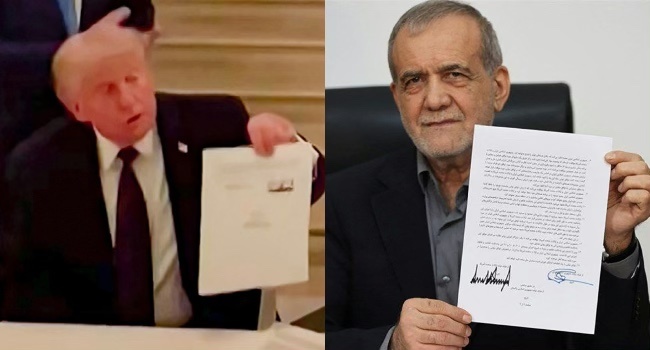
Despite the diplomatic deadlock, Iran’s President Masoud Pezeshkian vowed on Tuesday to match any US move to return to a deal aimed at ending the war.
He also warned that a return by the United States to “a policy of pressure and threats could derail the path of diplomacy”.
AFP
About The Author